
One platform, two jobs: manage the vendor, track the contract
Granur separates two things that usually get flattened into one: deciding whether a technology vendor is worth onboarding and keeping the ones you already have on track, and moving the actual contract through intake, review, negotiation, and signature. Both live on the same board, tied to the same vendor record — pick where you want to start.
What you get that a spreadsheet and an inbox can't
Visibility & control
One dashboard shows every vendor and every contract at whatever stage it's actually in, right now — not a status someone updates when they remember to, and not a scavenger hunt through an inbox after the person who ran the deal has moved to a different team.
Avoid costly leakage
Automatic renewal alerts, expiring-certification warnings, and obligation due dates catch what a shared calendar or someone's memory eventually misses — a single missed auto-renewal or lapsed cert can cost more than a year of the subscription.
Time back for your team
AI-assisted intake alone replaces manually keying in 20-plus fields from a legal document with reviewing and correcting a first pass — and that's before automation rules, reminders, and e-signature remove the rest of the manual follow-up.
Vendor quality & performance
A weighted, evidence-backed evaluation keeps a new vendor honest before you commit, and ongoing KPI health scorecards catch underperformance with an actual record — instead of a gut feeling nobody wrote down.
Faster time-to-value on strategic vendors
Faster routing and fewer stalled deals mean a new data platform, cloud service, or ad-tech partner gets through evaluation and into production sooner — instead of sitting in a review queue while the opportunity it was meant to capture goes stale.
Every function, built to save time and reduce risk
Intake & AI extraction
Upload a contract (PDF, DOCX, or text) and Claude pulls out the structured fields — vendor, dates, financials, business purpose — plus advisory flags like auto-renewal clauses, termination windows, and price escalators, into an editable review form before anything is saved. This is the single biggest time-saver in the whole app: instead of someone manually keying in 20+ fields from a legal document, they're reviewing and correcting an AI-generated first pass. It's also safer in a specific way — the advisory fields (auto-renewal, uncapped terms) surface risk language a busy reviewer might otherwise skim past.
Routing pipeline
Every contract moves through a fully customizable stage pipeline with parallel review tracks (Engineering, Business Owner, Finance, Legal, Security) and a phased checklist, all editable per org rather than hardcoded. “Gated” stages require owner or admin approval to enter. This replaces the spreadsheet-plus-email-thread way most orgs actually track contract review — it saves time because everyone always knows exactly which stage and which reviewer a contract is waiting on, and it's safer because approval gates are enforced server-side, not just a checkbox someone might skip.
Vendor evaluation (new vendors)
A weighted, evidence-backed rubric (Strategic Fit, Security & Compliance, Commercial & TCO, and more, each scored 0 to 5 against real evidence types like “PoC validated” or “reference customer”) plus mandatory pass/fail gates (SSO, SOC 2, data residency) that can't be scored around. This turns “we think this vendor seems fine” into a documented, defensible decision — the time savings shows up at renewal or audit time, when you have an actual record instead of institutional memory; the safety comes from gates that can't be overridden by a good weighted score elsewhere.
Vendor health & relationship management
Periodic KPI scorecards (Quality, Delivery, Cost, Service, Innovation, Communication) with an auto-suggested health rating, an offboarding checklist, certification and insurance expiry tracking with amber/red badges, and a spend-vs-risk segmentation map that surfaces which vendors actually deserve attention instead of reviewing every vendor equally. This is where ongoing vendor management time gets saved — instead of one-at-a-time vendor lookups, the segmentation map and scorecard list surface the outliers automatically.
Risk & compliance
A rule-based risk score runs on every contract automatically (new vendor, PII, missing VRA, high value, and more), and an on-demand AI pass reads the actual contract text for risky clause language with excerpts and severity. Compliance fields (VRA, privacy diligence, uses-AI flag) are org-configurable in label and order. Every mutation across the whole app is written to an audit log, exportable as CSV or PDF for a security reviewer. This is the core “why is it safer” answer: nothing changes in the system without a timestamped, attributed record, and risky contract language gets flagged even when nobody thought to look for it.
Financials & spend analytics
Per-contract financials (value, annualized value, currency) roll up into portfolio-wide spend analytics: totals, breakdowns by vendor, type, and stage, renewals at risk in the next 90 days, and top contracts by value. Saves the recurring “what are we actually spending with vendor X” question that otherwise means pulling contracts one by one.
Renewals, reminders & calendar
Automatic renewal surfacing sorted by urgency, personal email and push reminders with configurable lead time, and a personal calendar feed (.ics) of every deadline and open obligation. This is a direct answer to the classic CLM failure mode — a renewal or auto-renewal clause quietly passing because nobody was tracking it on a calendar.
Signatures & document versions
Token-based e-signature requests (no login required for external signers), automatic reminder cadence, auto-advance to “executed” once everyone's signed, plus full document version history with word-level diffing between versions. Saves the back-and-forth of “which version is current” and removes a manual step — someone marking a contract executed — from the process.
Obligations tracking
Post-signature commitments and deliverables tracked with owner, due date, and status, both per-contract and portfolio-wide, with overdue highlighting. This is the piece that catches what most CLM tools miss entirely: the actual promises made inside an executed contract, not just the contract's existence.
Automation, webhooks & integrations
A rules engine (stage-entered or checklist-complete triggers, Slack-notify or auto-advance actions) plus outbound webhooks (HMAC-signed) and a public read API for external systems. This is where the platform stops being something people have to remember to check and starts pushing information outward — Slack gets pinged, other systems get notified, without anyone opening Granur first.
Collaboration
An activity feed combining system events and posts, @mention notifications, comments on both posts and individual contracts, and a notifications bell ranked by severity. This keeps context — why did this deal stall, who flagged this risk — inside the record itself instead of scattered across email threads that eventually get lost.
Analytics
Cycle time (dwell time per stage, bottleneck detection), a full timeline of every key date and stage change, and natural-language portfolio search — “ask your contracts.” These answer process questions — where are things actually getting stuck — that are otherwise nearly impossible to reconstruct after the fact.
Admin & customization
A visual stage builder, checklist template editor, configurable compliance fields, contract templates, a reusable clause library, full team and role management, and Stripe-backed billing with quota enforcement. This is what makes the whole system fit a specific org's actual process rather than forcing one generic workflow on everyone.
See Granur in action
No sales call required — these are real screens from the actual product.
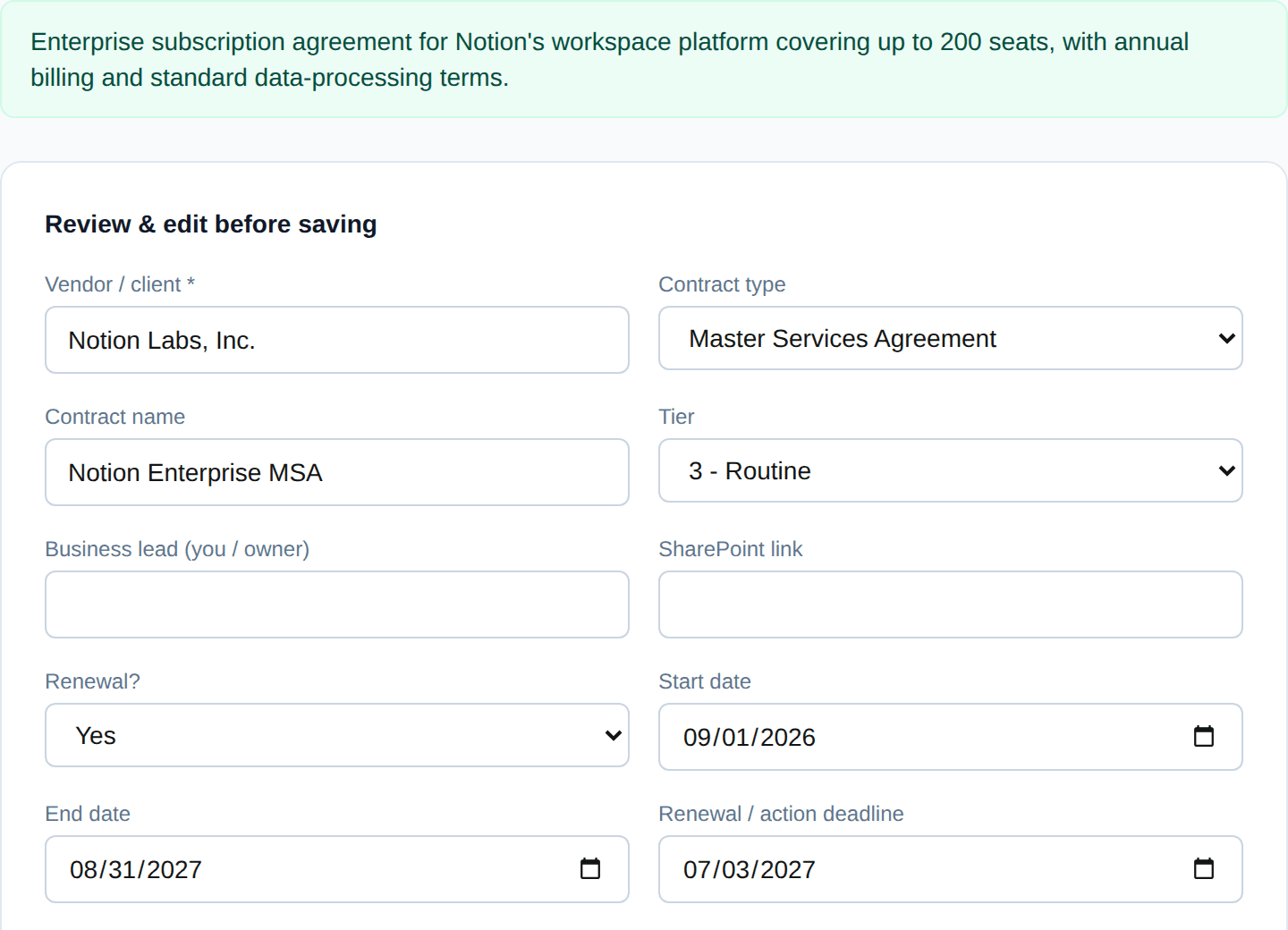
Drop in a contract and Granur reads it — vendor, dates, payment terms, financial terms — straight into an editable form you review before it's saved.
Two views into the same pipeline
Vendor Management
Every vendor in one directory — a weighted evaluation and mandatory gates for a first-time vendor, health scorecards, obligations, certifications, and portfolio segmentation by spend and risk for the ones you already have.
CLM & Contract Tracking
One dashboard for every contract, stage by stage — eight stages, five parallel review tracks, and three compliance gates, plus negotiation, e-signature, renewals, and spend tracking, tied back to the vendor it belongs to.
See it on your own vendors and contracts
Pick a plan, upload a handful of agreements, and watch evaluation, routing, and renewal tracking fill in together.